Friday, January 18, 2013

The Universal Language

This article by Joshua Foer in The New Yorker on constructed languages (e.g., Klingon, Esperanto, etc.) is good journalism, good prose, and an enthralling biographical sketch of a California DMV worker with a passion for linguistics.  The DMV worker spent 30 years of his life constructing Ithkuil, a new language.  (I'm imagining disgruntled California motorists waiting for their numbers to be called at the DMV during those 30 years.)  He publishes a manuscript describing Ithkuil on the Internet.  A Russian science magazine does a piece on the manuscript, although the DMV worker is unaware.  A couple of years go by and then . . .

In early 2010, he was forwarded an e-mail in patchy English from a Ukrainian academic named Oleg Bakhtiyarov, who introduced himself as the director of a recently formed institution of higher education in Kiev called the University of Effective Development, and as a leading proponent of a philosophical movement called psychonetics. When Quijada Googled both Bakhtiyarov and psychonetics, he found “a sea of impenetrable jargon” about “efforts to develop the human mind using a mix of Western and Eastern ideas,” but nothing that made him suspicious of the group’s motivations. The e-mail invited Quijada to participate in a conference titled “Creative Technology: Perspectives and Means of Development,” which was to be held that July in Elista, the capital of the Republic of Kalmykia, a small semi-autonomous state in the Russian Federation, situated on the arid western shore of the Caspian Sea.
Republic of Kalmykia?  Yeah, that was my reaction.  Just reading the Wikipedia page on the Republic of Kalmykia, "the only Buddhist region in the West," is its own adventure.   These people got the full Stalin treatment and then some.  For no reason at all, here is their flag:


 Here is their governor talking about his alien abduction and his plan to build a $10 million building in downtown New York City shaped like a king chess piece.

Anyway, the DMV worker accepts an invitation to go on an all-expense paid trip Kalykia to speak at the conference.  There, he's treated like a rock star because of the language he created.

That's just the beginning of this tale.  You'll have to read the rest for yourself.  (There's even a special appearance by George Lakoff, whose writings on language and metaphor I discussed in my Sunday morning Moral Imagination class, a couple of years ago.)

Reading The New Yorker article, speaking to how inefficient human languages (the real ones) are, and how much better language could be if it was designed through a rational process, I was reminded of Hayek's criticisms of philosophies that fail to respect the emergent nature of society.  Here's Wikipedia on "Emergence in Political Philosophy":

Economist and philosopher Friedrich Hayek wrote about emergence in the context of law, politics, and markets. His theories (Hayek 1973, p. 37) set out the difference between cosmos or "grown order" (that is, emergence), and taxis or "made order". Hayek dismisses philosophies that do not adequately recognize the emergent nature of society, and which describe it as the conscious creation of a rational agent (be it God, the Sovereign, or any kind of personified body politic, such as Hobbes's Leviathan). The most important social structures, including the laws ("nomos") governing the relations between individual persons, are emergent, according to Hayek. While the idea of laws and markets as emergent phenomena comes fairly naturally to an economist, and was indeed present in the works of early economists such as Bernard MandevilleDavid Hume, and Adam Smith, Hayek traces the development of ideas based on spontaneous-order throughout the history of Western thought, occasionally going as far back as the presocratics. In this, he follows Karl Popper, who blamed the idea of the state as a made order on Plato in The Open Society and its Enemies. Emergentism is a rejection of the state on the grounds that it is a perversion of the emergent rules that societies form spontaneously. Some 19th-century classical liberals, notably Gustave de Molinari and Frédéric Bastiat, were known advocates of an emergent society and wrote about the concepts in detail. See The Production of Security and The Law, respectively.


Maybe it's simpler to quote Hayek: “The curious task of economics is to demonstrate to men how little they really know about what they imagine they can design.”  Maybe the same could be said about the "conlangers" in The New Yorker piece.  So I appreciated the humility of the DMV worker in acknowledging that Ithkuil is an impractical language that would never be adopted.  As Lakoff says, it is more of a conceptual-art project.  


Tuesday, January 15, 2013

Pentagon Misleads Commander In Chief


"With respect to Private Manning, I have actually asked the Pentagon whether or not the procedures that have been taken in terms of his confinement are appropriate and are meeting our basic standards. They assure me that they are." - Barack Obama, White House Press Conference, March 10, 2011.

On Tuesday (1/8/2013), the military judge presiding over Manning's court-martial found, as the Guardian's Ed Pilkington reports, "that he was subjected to excessively harsh treatment in military detention" and is thus entitled to a reduction of his sentence if he is found guilty. Pilkington notes:

[The military judge's] ruling was made under Article 13 of the Uniform Code of Military Justice that protects prisoners awaiting trial from punishment on grounds that they are innocent until proven guilty. The recognition that some degree of pre-trial punishment did occur during the nine months that the soldier was held in Quantico marks a legal victory for the defence in that it supports Manning's long-held complaint that he was singled out by the US government for excessively harsh treatment.
 
Do you think President Obama will now go back to the Pentagon person he spoke with in 2011 and angrily demand to know why he was lied to? 

Saturday, January 5, 2013

The Cross and Lotus Blossom

I'm currently reading The Lost History of Christianity: The Thousand-Year Golden Age of the Church in the Middle East, Africa, and Asia -- and How It Died, by Philip Jenkins.  Here's a selection from the first chapter.

The Church of the East was anything but a newcomer in China, and Christianity first established itself in that land about 600, roughly at the same time that Tibet first welcomed Buddhism.  About 780, a Nestorian community erected a monument that recounted the Christian message in Buddhist and Taoist terms, just as European Christians were trying to make the faith acceptable to peoples of western northern Europe:


The illustrious and honorable Messiah, veiling his true dignity, appeared in the world as a man; . . . he fixed the extent of the eight boundaries, thus completing the truth and freeing it from dross; he opened the gate of the three constant principles, introducing life and destroying death; he suspended the bright sun to invade the chambers of darkness, and the falsehoods of the devil were thereupon defeated; he set in motion the vessel of mercy by which to ascend to the bright mansions, whereupon rational beings were then released; having thus completed the manifestation of his power, in clear day he ascended to his true station. 

I also thought the following information about the Christian influence upon Buddhist texts was interesting:

Around the the time this memorial was erected, in 782, the Indian Buddhist missionary Prajna arrived in the Chinese imperial capital of Chang'an, but was unable to translate the Sanskrit sutras he had brought with him into either Chinese or any other familiar tongue.  In such a plight, what could the hapless missionary do but seek Christian help?  He duly consulted the bishop named Adam, whose name headed the list on the Nestorian monument.  Adam had already translated parts of the Bible into Chinese, and the two probably shared a knowledge of Persian.  Together, Buddhist and Nestorian scholars worked amiably together for some years to translate seven copious volumes of Buddhist wisdom.  Probably, Adam did this as much from intellectual curiosity as from ecumenical goodwill, and we can only guess about the conversations that would have ensued:  So, what exactly is this "bodhisattva" we hear so much about?  Do you really care more about relieving suffering than atoning for sin?  And your monks meditate like ours do?  Scholars still speculate whether Adam infiltrated Christian concepts into the translated sutras, consciously or otherwise.  


Headstone of Mrs. Yap
Yuan Dynasty(1272-1368)


Tuesday, January 1, 2013

Envy and Politics

For the Sunday morning class I'm teaching on envy, I've been reading Envy: A Theory of Social Behaviour, by Helmut Schoeck.  It is a sociological study of envy.  The chapter on "Politics and the Appeasement of Envy" contains the following introductory paragraph:

It would be a miracle if the democratic political process were ever to renounce the use of the envy-motive.  Its usefulness drives, if for no other reason, from the fact that all that is needed, in principle, is to promise the envious the destruction or the confiscation of assets enjoyed by the others; beyond that there is no need to promise anything more constructive.  The negativism of envy permits even the weakest of candidates to sound reasonably plausible, since anybody, once in office, can confiscate or destroy.  To enlarge the country's capital assets, to create employment etc. requires a more precise programme.  Candidates will naturally try to make some positive proposals, but it is often all too apparent that envy looms large in their calculations.  The more precarious the state of a nation's economy at election time, the stronger the temptations for politicians to make 'redistribution' their main plank, even when they know how little margin is left for redistributive measures an, worse still how likely they are to retard economic growth.  

One might assume this was written upon the close of the 2012 election, but it was written in 1966.

Tuesday, December 18, 2012

Greece, Day Ten


(Rick's words are in black; Jenese's words are in blue.)

Oh-dark-thirty.  The alarm shredded apart the thin veil of sleep that had wrapped us for but a couple of hours.  We had to meet the taxi at 3 a.m.

Our flight's departure time was 6:50 a.m.  The original plan was to catch the very first metro train, which departs at 5:00 a.m., but when we shared this plan with the desk clerk at the hotel the night before, he convinced us that it would be cutting it too close.  (He was the same young man who advised us to park our car all the way up onto the porch, although we thought one wheel up on the curb should've been plenty, for Greece.  A darling, tanned lad, he tightened his lips and jaw into the most approved manner of managerial knowledge and authority, as he explained how we were just going to have to set the alarm early.  I wanted to pinch his cheeks, but chose instead to go upstairs and start packing.)  After going to bed, I had a brainstorm, which was to simply keep the rental car and drive ourselves to the airport.  I got back out of bed and called the rental company.  They told me that was doable for an extra drop-off fee, but he said they really don't like doing that, since they don't have an office at the airport.  I didn't like the idea of getting behind the wheel again, anyway, so I decided we would just take the airport bus, which runs from Sytagma all night long.  That would necessitate a taxi ride to the airport.  I always view getting into a taxi as a failure of some degree, but it was to be.

The taxi was on time.  We got in, and in less than two minutes, it seemed, the taxi pulled up behind the bus stop.  Just too late.  As we got out, the bus pulled away.  The cabbie flapped his arm a time or two, and I half-heartedly jogged about as many steps, but it was too late.  We were going to have to wait for the next bus.

I can't remember if we waited 15 minutes, or half an hour.  I do remember that a few more tourists, of varying nationalities and luggage preferences, were deposited by taxis to wait with us.  (It wasn't until the tourist numbers hit 7 or 8 that I began to feel at ease on this city sidewalk at 3:30 a.m.  I don't why I assumed that these other tourists had my back, but it worked.)  Syntagma Square sleeping.  Someone with a tanker truck was power-washing the square's pavement.  I remarked to Rick how clean these Athenians were.  It was not until after we were home that we learned the reason why the square needed scrubbing.

That would be the scrubbing away of tear gas residue, broken glass from Molotov cocktails, maybe some blood -- all the things that were hitting the pavement while we were blissfully unaware, driving through the orange groves.

Finally, the bus arrived, and we were back at Athens' airport.  One advantage of arriving so early, we told ourselves, was time to shop in the duty-free stores.


It also allowed us the additional time required to obtain our boarding passes from one of only two "automated" kiosks.  There was an airline customer service representative standing beside each kiosk, helping each passenger with the "self-check-in" process, since the machines seemed to respond only to the loving touch-screen taps and cooing of the CSRs.  (The process was the same at the Rhodes airport.)

There were several other kiosks available -- all lit up and inviting -- but no amount of touching the touch-screen would illicit a response.  Periodically, an impatient passenger would break free of the line and walk over to one of these other kiosks and start tapping.  Soon, they would pressing hard enough until their finger was about to pierce the glass screen and come out the other side.  Then they would give up and return to the line.  ("We knew you'd be back.")  All that was missing was an audible "WAUGH waughhhhh . . . " coming from the machines.  I was convinced it was it all a human behavior experiment.  Somewhere, someone was watching it all on closed-circuit TV and making notes.

After getting our boarding passes, we passed through a check station to enter into the ticketed passenger section of the duty free shops, which was extensive.  We had been shopping at one of the first stores when we heard yelling and turned around to see a dark-skinned man throwing a fit at the check station that we had just passed through.  He was yelling in French, which probably didn't have the effect he was hoping for, because a group of men and women in uniform wrestled him to the ground and pinned his arms behind his back.  My high school and college French faded long ago, so I had to speculate as to what he was yelling:  "No, I don't have a boarding pass!  Those touch screens don't work!"

The flight to Paris was greatly improved by the conversation of a friendly Texan woman on my left, who'd just spent several weeks in Greece with her husband, visiting one of their children.  We chatted off and on for most of the flight.  

As we drew close to Paris, the captain announced that head winds had so slowed our progress that some of us might miss our flights.  Panic and disorder ensued, like the Tower of Babel squeezed into a 747.  In an attempt to help us shave off a few seconds of scrambling through the airport, the flight crew began reading the gate numbers for all our connecting flights.  My new Texan friend softly mentioned something about Charles de Gaulle Airport being a mess to navigate.  She started hoping out loud for an excuse to spend the night in Paris.  I focused all my energy into listening intently, to decipher the letters and numbers from the thick accent of the crew member on the microphone.  When ours was announced, I scribbled it all down, and then consulted the airline magazine.  Ha!  I thought, a bit (too) triumphantly, and showed Rick the diagram.  It looked like our next gate was very close to the one at which we were going to arrive.

Little did I know that the Gallic gods of travel had swept Charles de Gaulle International Airport with an epic plague of construction and confusion, to satisfy their own dark mirth at the expense of us hapless mortals.  Scylla and Charybdis in berets, if you will allow the mixing of cultures for the purpose of metaphor.  And we were heading straight for their sneering maws.

Even with the delay, we had an hour to catch our next flight.  Plenty of time, right?

The first delay was caused by all the construction detours, which converted what looked like an inch on the diagram in the back of the airline magazine into a good half-mile trek.  The second delay was caused by what greeted us at the end of the trek, which was the largest passport control rope line I have ever seen.  This was totally unexpected.  We were passing from one EU country into another.  Wasn't the free movement across borders one of the selling points for the European Union?  What happened?  I know I've flown through Paris before without going through passport control.  I thought that surely this wasn't meant for us, but there was no way around it, so we joined the sad, slow, shuffle of defeat.  We knew immediately that any hope of making out connection flight was gone.


Sure enough, by the time we got to the head of the line, it was past our departure time.  But just to make certain that we wouldn't make it, the security screeners decided to interrogate me about my duty-free bag, containing vacuum packed black olives, ouzo (for Scott, to thank him for loaning us his iPhone), and several other items.  In a think French accent, the female screener asked me what I got.  "Uh, well, let me see . . . there's olives, ouzo . . ."  "No, no, no!" she said, "Not 'what,' WHERE?! Where did you get this?"  It seems that my duty-free bag did not look like the duty-free bags you get at the shops at Charles de Gaulle International Airport.  I explained that I got it in Athens, which seemed incomprehensible to her.  I can't believe that no one has ever passed through that line before after arriving from Athens, so maybe this was her first day, or maybe she's just surprised to learn that Greece still has an operating airport.  In any event, she had to call for other screeners to examine the bag, examine all the contents, and discuss, and then repeat.  Meanwhile, an exasperated Jenese was standing beyond the screener line, wondering what was going on.

I just know that if she'd have only let him through quickly, we could've made our connecting flight.

Once the screeners had satisfied themselves and returned my duty free bag, Jenese and I literally sprinted for our gate, where our plane was still parked, but the door was closed.  The CSR at the counter told us were were too late.  Now, I've sat at gates in the past and watched other people in this same situation moan, cry, and yell until the gate agent relented and opened the door and let him/her onto the plane.  This option was open to us, but I did not want to receive the same treatment as the gentleman at the Athens airport, who got a knee in the middle of his back.

We couldn't do anything for a moment or two, except pant.  The kind CSR and his cohort immediately began typing and making phone calls, and within about ten minutes, they had found seats for us on another flight, and we'd only have to wait about an hour and a half!  We accepted our new boarding passes with gratitude and meandered to the other end of the concourse, to our new gate.  We were going to be flying back into Atlanta, instead of Minneapolis.

The CSR was black, tall, slender, and had a shaved head, looking like an ESPN commentator.  He spoke English without an accent, helping us feel like somehow we had already made it to Atlanta.  That, plus his professional and helpful demeanor worked to set our minds at ease.

We wandered, visited the Internet kiosk, and munched on beef jerky (how treacherous that bag would turn out to be!).  Now, our seats for the flight were not together, which worried me.  When the three Js went on their famous British jaunt, we were forced to remain in our assigned seats -- I presume this was to make the identification of remains easier in the event of an unfortunate occurrence.  Rick, however, assured me that he'd never had such a problem, and most folks would be glad to switch seats, so a married couple could sit together.

He was right.  I should have trusted his greater experience.  After boarding, he lost no time in talking to the lady next to him, who graciously smiled, gathered her things, and motioned me over.  We settled in, luxuriating in the luck of being in a front row, with plenty of room for Ricky-length legs to stretch comfortably.

I enjoyed one minute of glorious comfort before musical chairs resumed.  The guy behind us asked us if we would switch seats with him and his wife.  They had a baby and had been promised the front row, which had a place for some sort of baby contraption, but somehow ended up being seated elsewhere.  I wanted to say, "Hey, parenting is filled with daily pitfalls.  Isn't it enough that you get a child tax credit when I don't?  Do I have to get leg cramps, too?"  But that baby was going to be directly behind me and crying in my ear, so whom would I really be hurting?  We switched seats and the couple, as well as the stewardess, was very thankful.

The video selections I made for the flight:  Moonlight Kingdom (too much whimsy and atmosphere and not enough character development; Bill Murray is wasted; but still an enjoyable ride), Abraham Lincoln: Vampire Killer (as ridiculous as it sounds, but well directed; surprisingly, has a good moral element, but is not fully developed), and an episode of Curb Your Enthusiasm that I had seen years ago.

Dinnertime approached, and the flight crew distributed the menus.  Never did I think I would ever find duck or camembert on an in-flight dinner menu.  Or even be offered a menu, for that matter.  This flight definitely gave British Airways, my airline gold standard, a run for the money.  The entrees were beef with broccoli and other vegetables, and canard avec I can't remember what.  And cheeses, all the bread you could stuff, and a delicate apple pastry.  We came up with sort of a game plan, to get one of each entree, which I promptly botched by asking for canard after Ricky did.  And poor Ricky, who despises mashed potatoes, could not consume this duck-ish version of shepherd's pie.  I thoroughly enjoyed it, but Ricky didn't want to bother the attendants by asking for another entree, and so made do with the camembert and bread.  It was probably just as well.  He also hates broccoli.

The rest of the flight progressed as you'd expect a nine-hour exercise in pretending to sleep would.  Long.  It's always such a relief to see the next airport, even if it's not the last stop before home.

At the airport in Atlanta, I thought it was a vain exercise, watching for our luggage on the carousel before passing through customs.  How could the airline have possibly pulled our bags from the missed flight and moved them to our Atlanta flight?  But the CSR at the baggage claims area told us to give it a try, and we had plenty of time, so we stood and watched.

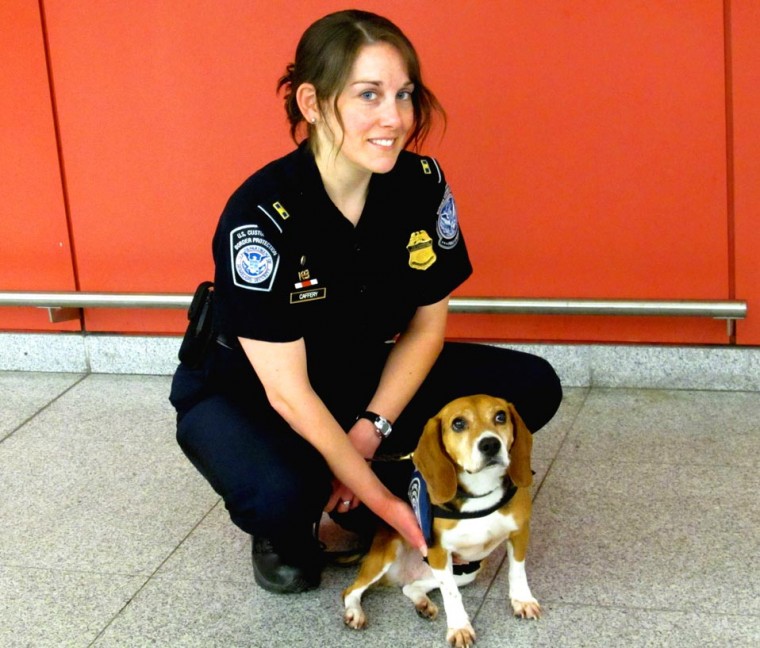
Soon, a uniformed U.S. Customs and Border Protection agent came by with a beagle on a leash, sniffing people and their bags.  Each bag would get about two seconds of the dog's attention, but my black backpack proved to be a source of prolonged fascination.  The beagle circled the bag, continuing to sniff, and then looked up at the agent.  The agent looked down at the beagle and, using her beagle/baby voice, asked, "What are you supposed to do?"  The beagle did some more sniffing and then laid one paw on my bag and looked up at the agent.

This is not the agent and beagle that we encountered, but close enough. 
This was enough to cause the blood to drain from my face.  It was probably a good thing that Jenese was there, because she didn't seem the least bit bothered by the little furry narc and was able to laugh and chat with the agent with a "ha, ha, I wonder what's in there that he likes?" sort of attitude.  I, on the other hand, adopted a cold, self-preservation attitude of "yes, boss . . . no, boss," knowing that the tap of that paw meant that at the very least, we were going to be subjected to the delay of thorough questioning and inspection, and at worst, we would be starring in a sequel to Midnight Express.

I didn't learn until later that the Beagle Brigade is not made up of drug dogs.  The beagles merely sniff out prohibited agricultural items.  So maybe I overreacted a bit, but the anticipated delay was indeed coming.  The agent asked us if she could look in the bag and I said the equivalent of "yes, boss."  Jolly Jenese volunteered that there was beef jerky in the bag and that the beagle must be smelling it.  I didn't say anything, but I assumed that the dog would be trained not to respond to tempting smells like that, so it must be something else.  My guess was that it was the chi mali (mountain tea).  It is found only in Greece and Albania and has a distinctive odor that is a bit like chamomile.  Since the beagle was unfamiliar with it, he hit on it.  (In my defense, I really didn't think about the tea.  And the beef jerky received much more scrutiny, later.)

Would you take this through Customs?
"Can we give him some jerky?" Jenese asked.  The agent smiled, but shook her head.  "No, he's not allowed to do that."

She asked to see our Customs Declaration form, which I knew would only spark more questioning.  That's because I determined long ago to always answer yes to every one of their overly-broad questions on that form, lest I fall into their trap.  Bringing in "fruits, vegetables, plants, food"?  Isn't that redundant?  Does that include a candy bar I bought in the airport?  That's food, right?  It certainly includes the figs and olives in my bag.  "Animals/wildlife products"?  Does that include a wool scarf or a leather wallet?  Been on a "farm/ranch/pasture"?  I walked across a field.  How should I know whether someone considers that to be pasture for their goats?  It's best to play it safe and check the "yes" box for all of these questions.  Besides, it has been my experience that it doesn't make any difference -- they just glance at the card and don't pay attention to what is checked.

That is, unless the Beagle Brigade sends up an alarm.  The Customs agent looked at the card and questioned us about our holiday ranching activities and the plants, seeds, and live animals we decided to bring home with us in our bags.  She made a little scribble on the card and sent us on our away.  I knew exactly what that scribble meant.  I don't know why she didn't simply direct us to the naughty room right then and there, rather than allowing us the false hope that we would be heading for our gate.

Oh!  But on an up-note, our luggage appeared on the carousel.  I was stunned.  It was a logistical miracle.  We picked up our luggage and headed for the exit.  We handed our Customs Declaration form to the agent at the exit and . . . he sent us to the naughty room.

(I have visited this room once, on the way back from Britain, when we Js were subjected to a shoe-scrubbing due to our admitting to traipsing through a field liberally decorated with "sheep pressies.")  You could feel the tension of the other passengers, muttering worriedly about making flights.  A Greek couple behind us, with their little dog in a carrier, had very little time before their connecting flight.  We offered to let them go ahead of us, and they gratefully accepted.  We chatted a bit.  Ahead of that couple was a family from India with about three carts loaded with taped boxes and huge suitcases, and a small toddler.  Slowly, the line crawled through the doorway.  Our disciplining (mustn't say punishment) began.

Step one involves waiting until an officer waves at you.  That means you're supposed to put your bags on the X-ray machine's conveyor belt.  Step two is standing awkwardly, watching your luggage disappear, until another officer waves you further down the line.  In step three, another officer rifles through your bags, right in front of you, and questions you about the contents of whatever catches his or her eye.  I'm not sure how many times I had to point out the beef jerky.  The ingredients were read, over and over.  The bag was opened and peered into.  "It's cow!"  I wanted to scream.  "It's not going to blow anybody up!"  They dug into our duty-free bag.  "What's in the olives?"  "Uh . . ."  "Any vinegar?"  "Uh . . . "  Then they found the tea. "What is this?"  "It's mountain tea.  It's really good."  Yeah, they've probably heard that one, before.

All of the U.S. Customs agents who spoke to us were immigrants.  I don't know why you would want to use agents who can barely speak English to question new arrivals, many of whom speak little or no English themselves.  My guess is that these "agents" are in fact recent arrivals who were caught with undeclared, prohibited agricultural items.  Their punishment is to work out their sin in the purgatory that is the Customs naughty room.

Try our jerky.
The agent who was so distracted by our beef jerky was African and could speak only in half sentences.  I told him we had the beef jerky when we left and that it came from Oregon, as stated quite clearly on the package.  This made no impression on him.  As far as he knew, Oregon is an island in the Aegean.

Finally, we were motioned to the end of the line.  We watched the Indian family's luggage being excavated (they must have been planning on an stay of a month, or more), until the Powerful Ones deemed us thoroughly chastened and thus ready to return to our better-behaved fellow passengers.  We sprang on our reclaimed luggage like starved hyenas on a gazelle, hastily repacked everything (duty-free must now go into checked luggage) and made for the door.

As we were repacking, we were able to observe the dressing down given to the Indian family.  They had enough spices in their bags to open an Indian restaurant and had declared none of it.  The customs agent, a Dominican, I believe, held up one particular plastic baggie and told the Indians it was a banned spice.  Waving around a lock-blade knife she used to cut open suspicious packages, she angrily chewed them out for not declaring on their declaration card that they were bringing the spices into the country.  (I'm sure we would have received the same lecture had we not checked the "yes" boxes on the form.)  The Indians maintained blank expressions throughout their reprimand.  They were probably struggling to understand the agent's English and were bewildered by the entire experience.  I'm sure they became even more bewildered when they were handed their uniforms and badges and assigned to their duty stations.  

As for our repacked bags, they would not remain packed for very long.  When we got back home, we found TSA cards inside each bag, informing us that the TSA had opened the bag (including the sealed duty-free bag), inspected the contents, and tried on our clothes.  But nothing was missing.  Even the replacement honey was present and accounted for.  

Once we found our gate and sat down, exhaustion quickly set in.  From that point on, we were travel zombies.  Neither of us remember boarding the plane or taking off.  I looked out the window, expecting to see the tarmac, but instead saw city lights far below us.  Before I knew it, we were touching down in Tulsa.

And I thought I couldn't sleep on a plane.  I just haven't been tired enough!

My dad greeted us near the baggage claim area.  We retrieved our bags and found Donnie, my brother-in-law, waiting for us behind the wheel of his new Hyundai at curbside.

It was a struggle to stay awake, to answer their questions about our trip.  [Back in our little yellow house,] Indignation over our pawed belongings gave us just enough energy to do a bit of unpacking and snacking before we lost consciousness.  

Home!

It was a very enjoyable trip.  I encourage everyone to visit Greece before they turn the lights out.



Thursday, December 13, 2012

No Grace Period

I received my credit card bill, yesterday, and was surprised to learn that I'm still paying for the Greece trip, which occurred in October.  Specifically, I'm still being charged interest and fees for the emergency cash advance made on my card when we were in Lindos and Jenese's own card stopped working (which I previously blogged about here).  This is not discernible from my statement -- it simply shows:

12/04 - INTEREST CHARGED TO STANDARD PURCH - $9.91
12/04 - INTEREST CHARGED TO STANDARD ADV - $0.40

In case that isn't clear, there's another box at the bottom of the page that shows:

Interest charge calculation

Balance type          APR            Balanced Subject to Interest Rate             Interest charge
Standard Purch         14.18%                     $796.84                                              $9.91

There can't be any questions about that, right?

Well, I had some questions, so I called customer service.  The robot seemed completely baffled by my questions, so it went to look for a sentient flesh sack, also known as a customer service representative.  "DANGER, WILL ROBINSON!  DANGER!"

The CSR began his explanation by telling me that I should ignore the $798.84 figure, since it would just confuse me.  I was indeed confused, since that "balance" does not appear anywhere else on my statement, or any prior statement, and no amount of mathematical jiu jitsu on my part could produce that figure.  He said it was a running average balance amount that they are required by law to disclose.  I really appreciate consumer protection laws that require disclosure of numbers that I must completely ignore, lest I be confused.  Don't you?  Maybe it would help if that same law also required that "<---- ignore this" be printed next to the "running average balance."

As for the "INTEREST CHARGED TO STANDARD PURCH" on 12/04, I was tempted to allow confusion to set in, but the CSR helped me to understand that the interest had nothing to do with a purchase, nor did anything actually occur on 12/04.

After the CSR gave me the same explanation multiple times, it began to sink in that the crux of the matter was that by taking a cash advance in the first part of October, I had entered the dark forest of No Grace Period.  My own explanation of the explanation is probably wrong, but this is how I understand it.  Normally, no interest accrues on your balance between the time you make a purchase with the card and the payment due date.  That is the "grace period."  But if you get a cash advance on your card, the grace period is suspended until the loan amount and all interest is paid off.  Consequently, when you receive your next statement, it will show the amount "currently due" and the "due date," but interest will be accruing until paid, even if paid by the due date.

Do not enter the No Grace Period
So my October bill included outrageous interest charges and cash advance fees, which I expected and was prepared to swallow.  I paid the full amount prior to the stated due date.  What I did not know, however, was that I need to tack on an extra amount to cover the interest that would accrue on the balance, as well as on subsequent purchases, between the time the statement was printed and when my check would be received.  That additional accrued interest amounted to $9.91.

I asked the CSR if the same thing was going to happen this month, meaning that interest was accruing as we spoke, and he said no.  But I don't see why it wouldn't, since I remain stuck in "No Grace Period" until all interest charges are paid off.  So to be safe, I'm mailing in an extra $50, this month.  I hope there is not an over-payment fee tacked onto next month's bill.

Monday, December 10, 2012

Greece, Day Nine


(Rick's words are in black; Jenese's words are in blue.)

We began our day with the usual complimentary breakfast, but with the added treat of fresh figs in our yogurt and honey.  Those would be the figs we purchased from a fruit cart the previous day.  Wow, that's a good combination.

It was my very favorite breakfast of the trip.

A young guy wearing an army surplus jacket delivered our rental car to the front of the hotel and met us in the lobby to take care of the paperwork.  Initially, he offered to drive us to the outskirts of Athens before handing off the keys, which sounded great to me, since my anxiety over driving in Athens traffic was building by the minute, but he ultimately decided that it made more sense for me to join the fen of Fiats and asphalt (but no honking) right were we were at.  That's because the street running in front of the hotel would become the highway that would take us all the way to Corinth.  "Just go straight, straight, straight," he said more than once.

I had read that there would be toll booths along that highway, but I didn't know whether I would need exact change for the tolls, so I asked the guy.  I should have been more precise, because he got down to basics, drawing a diagram of a toll booth and explaining how to stop and pay the attendant.  I wanted to say, "Oh, I know what a toll booth is.  I'm from Oklahoma."

He took us out to the car, which was a little Fiat just like the one we rented on Rhodes, except that it was silver and the interior was dustier.  (Our raspberry Fiat was the cleanest rental car I'd ever seen.  And no wonder:  The owner of Zeus started scrubbing the thing down almost as soon as we dropped it off.)  He started to explain how to put it into reverse, but we stopped him, telling him that we were experienced Fiat drivers.  Do we look stupid, or something?

He laughed when we explained how we'd come by our expertise.

He left us and we arranged ourselves in the car and checked multiple maps, including the one on the iPhone, before deciding it was go-time.  That's when I realized I didn't have the key.  A five-minute search ensued: seats, floorboard, backseats, bags, pockets.  Giving up, I decided to go to the front desk to call the rental company to tell them that the idiot who brought us the car ran off with the key.  As I started to walk away from the car, I spotted the key still in the door.  Oh.

You're welcome.  It's easier to spot stuff when someone else suggests it.  Now, would everyone like to hear the song I made about our raspberry Fiat?  I've been waiting for an opportunity to share it with you.  Now would be a good time, since we're going to be in the car for a while.  You can probably guess the tune.  Sing with me! 

Back in the car, we looked ahead and noticed a road angling off to the right and a sign containing the Greek word for Corinth pointing in that direction.  We drove a raaaaasberry Fiat . . .  This prompted a debate about the meaning of "straight, straight, straight," with me ultimately deciding that "straight" meant straight, regardless of the sign.  There were objections from the co-pilot seat, but I put the car in gear, took a deep breath, and merged into the most dangerous traffic in Europe.

 The kind you find at E-U rent-al car stores . . .

It really wasn't bad.  The traffic flowed smoothly, everyone stuck to their lanes, and I never had to make any turns.  We went "straight, straight, straight" until Athens was behind us.  Raaaaasberry Fiat . . .  The sea came in and out of view on our left, and then we started passing through long tunnels bored through the beige limestone.  The traffic really thinned out and I was surprised by how few exits or crossroads there were.

Really was small, but we wouldn't pay for more . . . 

This made the sight of the toll booths all the more surprising.  The road suddenly widened to about fifteen lanes, with just as many booths straight ahead.  They were clean and modern looking, with slick digital directional boards.  I don't think all of them were manned, but most of them were.  I've never seen so many toll booths in one place.  (Obviously, there were no lines.)  Raaaaaspberry Fiat . . .   Farther down the road, we came upon an identical row of toll booths, but these were all dark -- the best kind of toll booths.  Maybe austerity measures have taken a whack out of the toll booth worker corp.  (When a government starts laying off tax collectors, things are getting really bad or really good, depending on your perspective.)  I think I loooo-o-o-ove you . . .  Of course, if they would simply move half of the workers from the first row of toll booths to the second, everything would probably go just as smoothly.

Wasn't that fun?  I had to amuse myself while we were driving on Rhodes, because Rick couldn't stand the distraction of incomprehensible Greek radio in the midst of nerve-wracking Greek traffic.  I didn't make up a song for the silver Fiat, though.

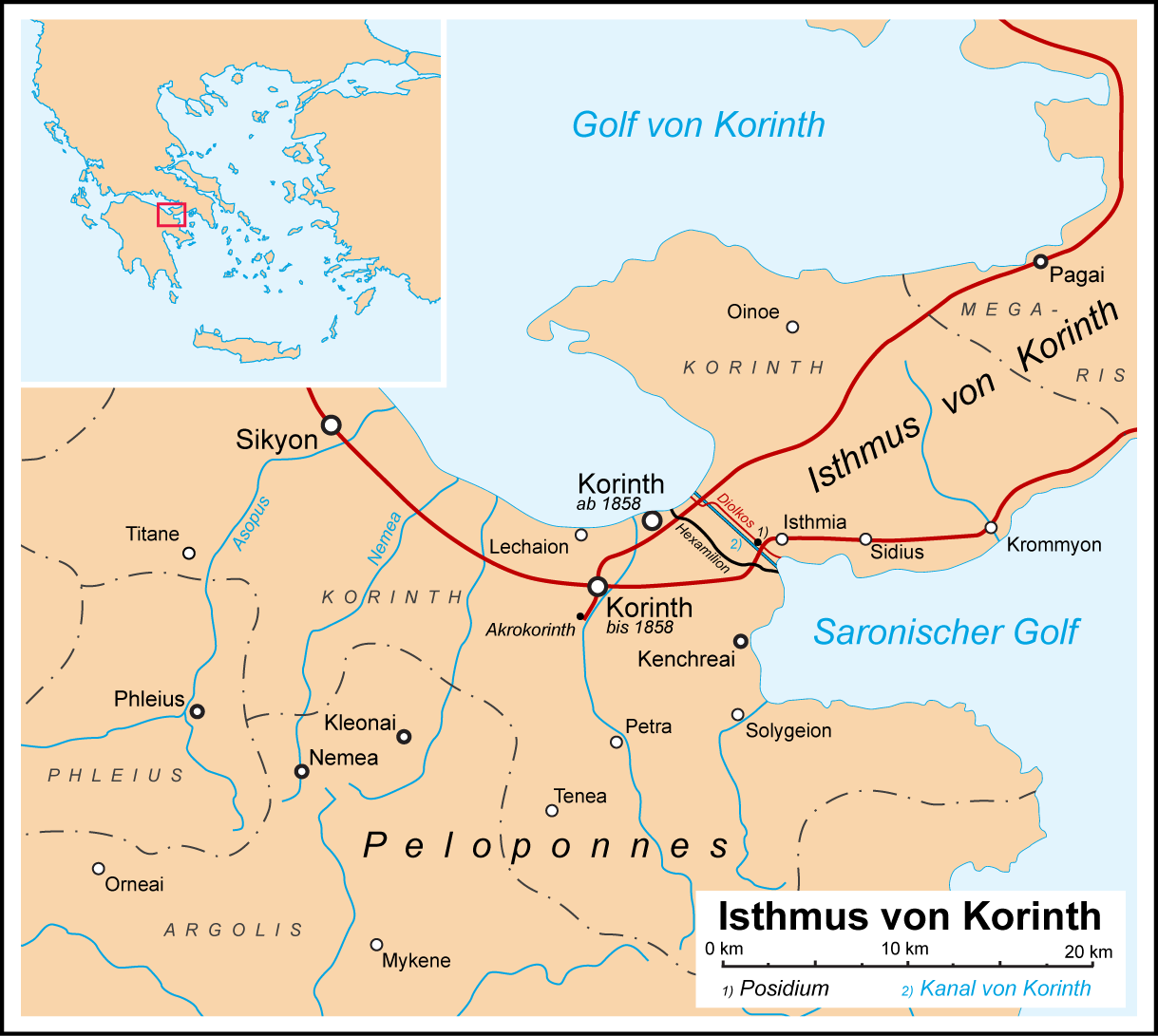
Our first tourist stop of the day was the Corinth Canal.  It's a canal that connects the Gulf of Corinth with the Saronic Gulf and the Aegean Sea.  The canal consists of a single channel 26' deep, excavated at sea level (thus requiring no locks), measuring 20,820' long by 81' wide at the top and 70' wide at the bottom. The rock walls, which rise 300' above sea level, are at a near-vertical 80° angle.


The canal has a fascinating history, almost none of which we were aware of when we were there, since we were on our own without a Dino.  I've since learned that the canal was first proposed in the 7th century BC, first attempted by Nero in 67 AD, but not actually completed until 1893.  The project was considered a failure at the time because so few ships opted to utilize it due to the narrowness of the canal and the strong winds.  Today, even fewer ships utilize it, most of which are tourist boats.  It's still impressive to look at, though.


We drove over the bridge and parked in front of the Greek equivalent of a Stuckeys or a Flying J.  There were already a couple of buses parked there, which had brought in loads of Greek teens on a field trip.  Those same teens were now clogging the narrow pedestrian section of the bridge, so it took us a while to worm our way to the middle so that we could pier over the rail.  We then continued across and then crossed back over the twin bridge going the other direction.  I spotted a bungee jump office, which was tempting, but it didn't seem to be operating at that moment.  Before hitting the road again, we went inside the store to browse among the touristy knickknacks.  We bought a bag of white figs, which Rick Steves recommended that we try.

The restrooms were so clean that Rick left a tip for the janitorial staff.  Really.

From the canal, instead of backtracking and getting back on the highway, we continued driving west, hoping we could reach Corinth this way.  Sure enough, we ended up driving through the new city of Corinth (Korinthos), which is a dull-looking place, and then finding signs that directed us to Ancient Corinth, which is several miles outside of Korinthos.

Ancient Corinth is an inhabited town of several thousand.  The ruins of 1st-century Corinth, which is what we were trying to get to, are at the center of the town, but finding those ruins was not easy.  There were road signs, but at some point they just stopped, so we must have misconstrued the pointed direction of the last one, causing to get lost.  We shot through Ancient Corinth and then turned around and just started driving around aimlessly.  We started seeing signs for a castle, indicating it was located at the top of the mountain that rises above Ancient Corinth.  We knew nothing about there being a castle in the area, but we decided to check it out, thinking that we might be able to spot the ruins from atop the mountain.

Another unlooked-for Greek treasure!

Acrocorinth
The castle turned out to be a massive fortified citadel called Acrocorinth, which is also the name of the mountain.  It certainly dwarfed any of the castles we had seen on Rhodes.  It was continuously occupied from archaic times to the early nineteenth century.  The highest peak on the site was home to a temple to Aphrodite during the time that the Apostle Paul was at Corinth.  (It would later be used for Christian worship.)    The citadel was heavily fortified during the Byzantine Empire; then became a a fortress of the Franks after the Fourth Crusade; then the Venetians; and finally the Ottoman Turks.  You can see the remains of construction from all these eras, but there were very few explanatory signs and we had no guide, so once again we were clueless as to what we were looking at.  We just wandered around (for free!), repeatedly saying, "Cool!  Look at that!"  We didn't even make it to the remains of the temple to Aphrodite, since we didn't know it was there.


Of course, the view was spectacular.  We could see far out into the Gulf of Corinth.  Also, just as we had hoped, we were able to look over all of Ancient Corinth below us and spot the ruins we had been searching for.  Actually, we spotted them when we were only half way up the mountain.  We saw columns and tourist buses, which was all that we needed.

Ancient Corinth exceeded all of my expectations and ended up being one of my favorite sites on our trip.  I didn't think there would be a lot to see there, and that it wasn't a big tourist draw other than for bible tourists.  It turned out that the archaeological site was quite extensive, with a lot of structures that would have been in existence during Paul's stay in the city.  Pottery suggests that the site was occupied as far back as 6500 BC, but the Corinth of Paul's day was distinctively Roman, having been destroyed by the Romans in 146 BC and then rebuilt under Julius Caesar in 44 BC.

It's a bit difficult to picture it as it might have been, as you walk between the foundations left intact, and the rubble gathered into neat piles.  I found myself wishing for a three-dimensional model.

The site is dominated by the Doric temple of Apollo, built on a rocky hill.  Seven columns are still standing.  The main agora runs to the south of the temple, flanked by a series of shops and stoas.  There are the remains of sanctuaries, temples, theaters, fountains and public buildings.

Temple of Apollo with Acrocorinth in background
For us, the highlight was the bema (tribunal), which is a platform from which Roman officials would have passed judgment on legal matters.  It stood along the south edge of the agora's central section. It is from here that Paul spoke to the Corinthians as recorded in Acts 18:
And when Gallio was deputy of Achaia, the Jews with one accord began an insurrection against Paul, and brought him to the judgment seat, saying, “This fellow persuadeth men to worship God contrary to the law.” And when Paul was about to open his mouth, Gallio said unto the Jews, “If it were a matter of wrong or wicked lewdness, O ye Jews, reason would have it that I should bear with you. But if it be a question of words and names and your own law, look ye to it; for I will not be judge of such matters.” And he drove them from the judgment seat. Then all the Greeks took Sosthenes, the chief ruler of the synagogue, and beat him in front of the judgment seat. But Gallio was concerned about none of those things.
(Gallio was the son of Seneca (a Roman rhetorician ) and the elder brother of L. Annaeus Seneca ( Roman philosopher). At Rome he was adopted by L. Junius Gallio, a well-known rhetorician, from whom he took the name of Junius Gallio. Archaeological evidence has been found confirming Gallio was the proconsul of Achaia, just as the book of Acts had recorded. At Delphi, archaeologists found a stone which might have once been attached to the outer wall of the Temple of Apollo. Inscribed in it is a copy of a letter from Claudius to the city of Delphi, naming Gallio as proconsul of Achaia.)

It was a thrill to be able to stand on the spot where this encounter took place.  (Although, there is a minority view saying that this would have taken place at another building in town that served as a basilica.)  There were a man and two woman there who were obviously aware of the bema's significance and were excited to be there.  The man was deaf, so Jenese assumed the women were, as well.  Using sign language, she asked one of the women to take our photo.  The two of them signed back and forth until Jenese got overwhelmed and the woman started speaking, explaining that she's not deaf.  We learned that they were Jehovah Witnesses from New Zealand.

Well, the interpreter was from New Zealand, but the gentleman was actually from Denmark, I believe.  And they used American Sign Language!  Small world, this.

The Bema
They were not the only tourists drawn to Corinth because of the biblical connection.  There were quite a few tourists there, many of them American, who had that church-going look about them.

I never thought I'd get to be a pilgrim, of sorts.

We spent a great deal of time at this archaeological site.  We walked the Lechaion road, which was a paved street that led from the agora, through a monumental propylon, to the port.  We could imagine Paul walking down that street, past the shops and the and the Peirene fountain (which the ancient Greeks believed to be the favorite watering hole of Pegasus).  We didn't have a Corinth audio guide by Rick Steves, but we had something even better -- a podcast of Dino Roussos at a Harding University lectureship, describing Ancient Corinth.  (It can be found on iTunes.)  It was not as good as having Dino actually with us, but it informed us of some facts we otherwise would have missed.

Peirene Fountain (baths)
For instance, archaeologists discovered an inscription dating to the 4th-century AD identifying a synagogue at Corinth.  This is after the time of Paul, but it confirms that, at least at that time, there was a large Jewish population in the city.  Also, near the theater, there was found  an inscription dating to the 1st century that reads: “Erastus in return for his aedileship [position as magistrate] laid [the pavement] at his own expense."  In Romans 16:23 Paul conveyed greetings to the Roman church from several people, one of whom was “Erastus, the city treasurer.” Since Paul almost certainly wrote Romans from Corinth, Erastus was probably the treasurer of the city.   Jenese and I visited the theater, which is away from the main archaeological site, but we did not find the Erastus inscription.

Lastly, we visited the museum, which contains a wide assortment of archaeological finds yielded by excavations in the area.  (The largest archaeological heist in history occurred here in 1990, with the stolen objects ending up in Florida.)  It was the usual stuff, except for a collection of various sculpted body parts, including genitalia.  These items are votive offerings recovered from the temple of Asklepion (according to a website I just now found), the god of healing (from which we get the modern symbol for medicine with the staff and the serpent).  It is not known whether they served as offerings meant to solicit healing that had not yet happened, or as thanks offering for healings of a particular part of the body.  It is in 1 Corinthians that Paul talks about the body of Christ and speaks of various body parts in doing so. I wonder whether Paul had seen these clay body parts being made in shops in Corinth.

When we arrived in Greece, our somewhat fuzzy itinerary called for heading west from Corinth to Diakofto, where we would go on a scenic ride through the Vouraikos Gorge and up a mountain via a rack railway.  But Dino told us there was no way we could do that and also see Corinth on the same day, unless we started at 6 a.m., so we nixed that plan.  Instead, we followed Dino's recommendation, which was to head south to Mycenae.  This took us through arid, sparsely populated mountains.  Although we we continued to travel on a highway, we did not pass through any cities, but only small towns and clusters of houses.

And beautiful groves of orange trees, laden with green fruit.

I knew I would be seeing some really old, busted-up stuff in Greece, but I had no idea I'd be walking through a still-standing gateway that dates to the 13th-century BC.  (To relate this to Bible history, it would be just before the time of King Saul.)  This is why Mycenae was amazing.  It was the center of the Mycenaean civilization that existed between the 16th and 12th-centuries BC.  The Mycenaean acropolis housed the royal house of the Atreidae and their people.  If that's not old enough for you, how about archaeological finds made on this hill that go back even further, possibly to the dynasty associated with the founding father of Mycenae, Perseus and his descendants, down to the king Eurystheus, who imposed the "twelve labors" on Herakles (Hercules)?  The dynasty of Atreus and his descendant, Agamemnon, who led the Greek expedition against Troy, followed.  Consult Homer for further mythical details (or Hollywood for myths of myths).

I still can't wrap my brain around just how very ancient these stones are.  And we could touch them!  I had to wonder about the lives of these long-dead people, and what life would have sounded like, in this citadel.  We were almost the only tourists there, and it was very quiet, except for the occasional clanking of goat bells on the high hills surrounding us.

Lion Gate
The gate I referred to is known as the Lion Gate, because covering the triangle above the lintel is a relief group of two lions.  After passing through the gate and entering the citadel, you pass a "Grave Circle A," which was a cemetery of royal tombs dating to the 16th-century BC.  This was the most discernible structure within the citadel -- everything else was just short rock walls and foundation stones.  You could also descend the original steps leading down into the cistern that the Mycenaeans used as their water supply within the defense walls.

Fearless explorer Rick actually descended the steps for some way into the darkness, muttering about how we should have brought flashlights.  Less-than-courageous Jenese stayed on the steps that still see sunshine, nervously waiting for the "YAAAAAAAAHHHH!!!!!!!!" that would herald the stumble and fall of the aforementioned explorer into the abyss.

Grave Circle
Looking out from the cistern
Once we finished our self-guided tour of the citadel, we walked through a really nice, modern museum, designed in a way to blend into the landscape.  It was filled with objects dating to the 16th-century BC. and beyond.  Except for one other couple, we had the run of the place.  The staff appeared to be on a perpetual coffee break in the outer courtyard.

Entrance to tholos tomb
Inside the tholos
A quarter mile back down the road we had driven in on was the Treasury of Atreus or Tomb of Agamemnon.  It is a "tholos" tomb that dates to 1250 BC. (which predates Atreus and Agamemnon).  It is formed of a semi-subterranean room of circular plan with a corbel arch. With an interior height of 44' and a diameter of 47.5', it was the tallest and widest dome in the world for over a thousand years after its construction.  The lintel stone above the doorway weighs 120 tons, the largest in the world.  You can't fully appreciate the scope and size until you walk to the center in the semi-darkness (no artificial lighting) and look up to the tip of the conical ceiling where bats undoubtedly roost.  The sound of the rapid-fire echo of my footsteps bouncing off of the curved walls added to alien look and feel of the place.  (Again, Rick was drawn to a deeply dark antechamber, which he felt compelled to enter.  I guess I'd better start packing flashlights, if only for my own peace of mind.)  I was so impressed that I decided to put off dying until I can afford a tholos tomb of my very own.  Maybe I can be buried in the Bartlesville mound beneath the water tank.

Leaving Mycenae, we continued further south, passing through miles and miles of orange groves, until we arrived in the seaport town of Nafplio on the southern coast of the Peloponnese.  Nafplio was the capital of the First Hellenic Republic, from the start of the Greek Revolution in 1821 until 1834.

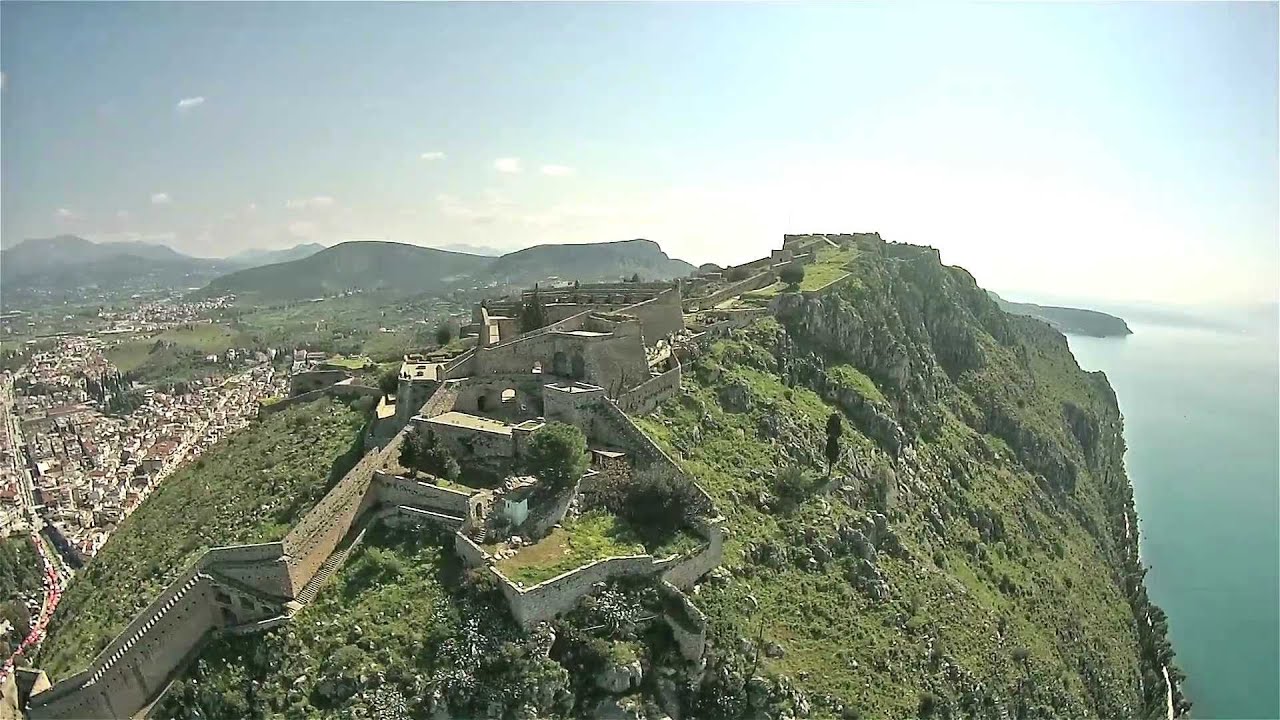
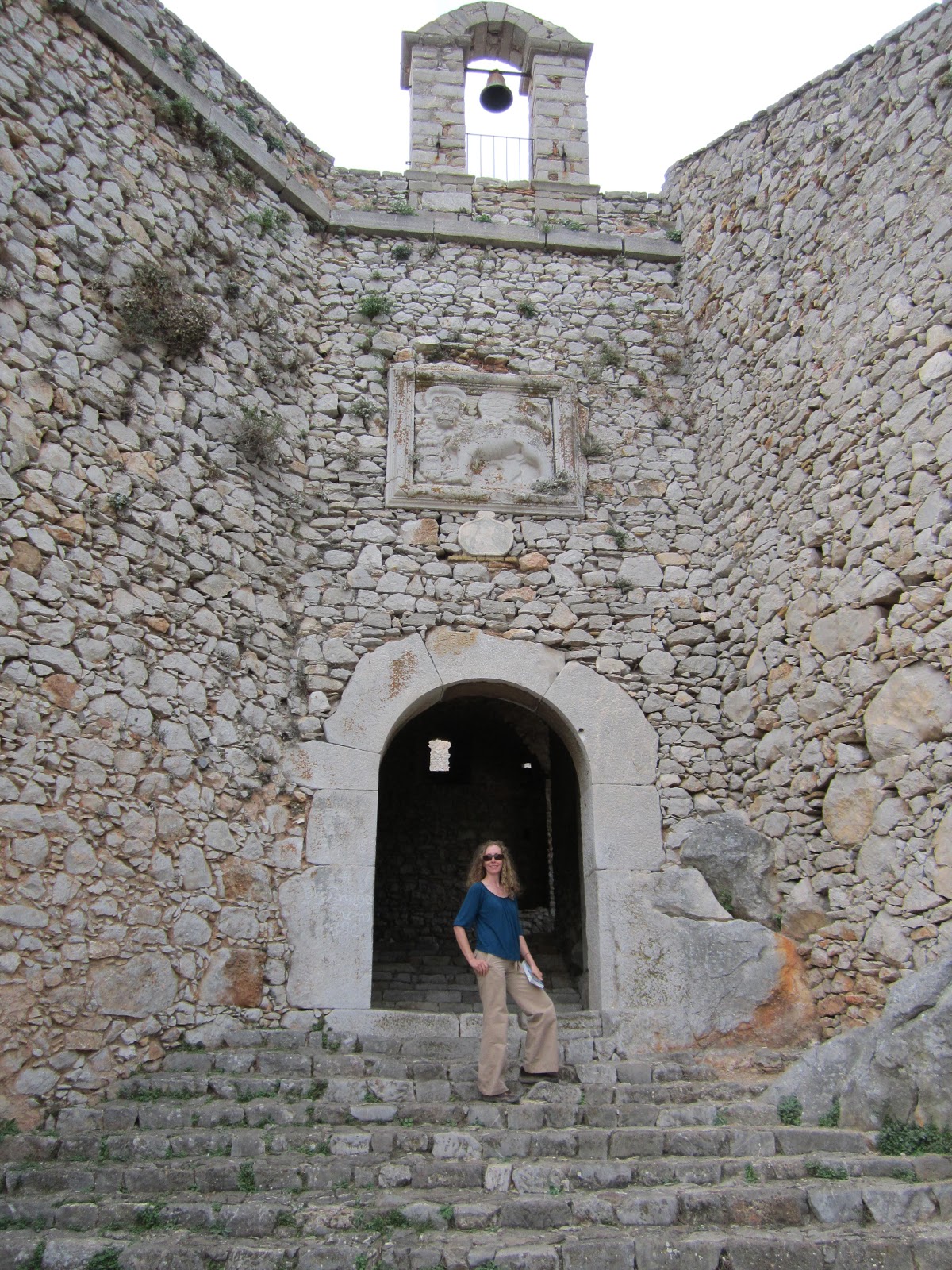
We still didn't have our fill of fortresses on this trip, so we headed straight for the Fortress of Palamidi, which is on the the summit of a hill above the city.  It was constructed by the occupying Venetians between 1711 and 1715, but fell into the hands of the Ottomans before it was completed. It is composed of a complex of bastions, munitions depots, food storage areas, barracks, moats, and other cool stuff such as these, all in movie-set condition.

Gorgeous.

It was already getting late, so we feared it would be closed, but the gate was still open.  The man at the ticket window told us they were closing in 12 minutes and we should come back another day.  This would have dissuaded us, but for the inspiration of a family who entered just ahead of his.  "If they can see all of Palamidi in twelve minutes, then so can we."

Lion of Venice at Fortress of Palamidi
We practically sprinted down and up cobbled walkways and stairs, going from bastion to bastion, pausing only briefly to take in the panoramic view of Nafplio and the bay, complete with another castle on a little island, from the fortification wall.  We even managed to waddle through a small passageway that lead to a windowless quadrangular room that is known as the "prison of Kolokotronis."  It wasn't exactly a dungeon, but it was small and dank enough to make you shudder at the thought of being shut up inside.  Only after returning home and studying the brochure we were handed did I learn that it was never a prison, but merely a gunpowder magazine.  Fooled again!

Inside the Bastion of Agios Andreas at Palamidi
View of Nafplio from Fortress of Palamidi
Nafplio has a lot of small museums and galleries, but it was already getting dark when we finished our dash through the fortress, so we drove to Old Town to look for a place to eat.  I hadn't been impressed with the look of Nafplio, but that changed after we parked and entered the pedestrian zone of Old Town, which occupies a peninsula extending into the Agrolic gulf.  There are a lot of cobbled alleys winding through attractive neoclassical buildings and mansions and beneath Venetian balconies.

Very scenic.  I can definitely see why Mr. Steves recommends staying a night or two.

Looking for the cafés listed in our Rick Steves guide, we walked along the port.  We found one in our price range with outdoor seating under a large canopy and with a view of the sea, reminding us of the Ostria taverna on Patmos.  The deja vu continued with our meal:  Gavros (deep-fried sardines), calamari (fried instead of grilled, this time), taramosalata (that wonderful fishy dip), with toasted garlic bread.  One of the few differences between these eating experiences was that at Ostria, the beggar at our feet was a roly-poly dog, whereas at this place, it was hungry cats.  When the waiter's back was turned, we would toss gavros to the cats.  We were competing against another generous diner several tables over to see who could offer the most appealing scraps.

One, jet-black, would stare you out of countenance with its yellow eyes -- you could feel it willing you to toss another tidbit.  The other, a brindle and white, sat at my feet, gently reminding me of its presence with a soft pat of its paw on my leg.

We had noticed a large number of confectionery shops in Old Town and thought this would be the perfect night (and maybe our last opportunity) to treat ourselves to some authentic Greek baklava, but the our waiter blew our plan by bringing us two pieces of complimentary cake.  It tasted of lemon and was soaked through with some type of syrup.  It was too sweet for us non-sugar eaters, but it had a good flavor, so we cleaned our plates.

Rick had stepped inside to visit the men's room, when the waiter materialized with the cake.  "What's this?" I asked, laughing in surprise.  "On the house!" he answered.  It was a tasty mystery.

It was now raining, which is an infrequent event in October, and especially this year, when Greece has been experiencing a drought, just like Oklahoma.  We hoped to wait it out, but soon gave up and made the long wet walk back to the car.

It was bound to happen, at some point.

We thought about returning to Athens by driving along the southern coast in order to avoid backtracking, but we were unsure of how long that would take, and we wouldn't be able to see anything in the dark anyway, so we decided to simply go back the way we came, through the orange groves and past Mycenae.  It rained off and on, but there was very little traffic, so it wasn't bad.  I spotted a roadside fruit stand that was still lit up, so I pulled over, hoping to replace the honey stock that was pilfered by the airplane baggage handlers.  An elderly man emerged from a cafe on the other side of the road and quickly came over.  He was one of the few Greeks I met who spoke no English, but this was no barrier to my purchase of two large jars of thyme honey.  (They were cheaper than the honey we had seen in the Athens touristy shops.)  I said good-night in Greek, and he said it back to me with a smile, and I hurried back to the car where Jenese was waiting.

Our only other stop was a gas station just outside of Athens, where a female attendant helped me with the delicate exercise of filling the gas tank to the level where it was when I got the car and not a bit more.

The man who'd forked over some money to tip a restroom janitor was now explaining to the attendant why he only wanted 8 euros' worth of gas.  I stayed in the car.

Once we hit Athens traffic, my anxiety level shot back up, but all I had to do was drive "straight, straight, straight."  We passed our hotel, which caused some panic, but then immediately hit a roundabout, allowing me to turn around, return to the hotel, and park the Fiat where it had been that morning, all as if on purpose.

Relief.